Cross-Border Digital Payments, Hydropower Trade, and $9.38 Billion Commerce Anchor India–Nepal Ties
NEW DELHI / KATHMANDU — Bilateral commerce totaling $9.38 billion in the 2025–26 fiscal year, newly launched peer-to-peer digital remittance rails, and expanded cross-border electricity transmission define the current trajectory of India–Nepal relations following Nepal’s March 2026 parliamentary elections. Supported by over 40 institutional dialogue mechanisms, New Delhi and Kathmandu have accelerated cooperation across physical transit corridors, artificial intelligence research, judicial assistance, and disaster reconstruction.
Commerce Dominance and Trilateral Power Grid Integration
India remains Nepal’s largest trading and investment partner, absorbing more than 80 percent of Nepal’s merchandise exports during the 2025–26 fiscal cycle and accounting for roughly one-third of its external services trade. Approximately 150 Indian commercial enterprises operate inside Nepal across banking, insurance, telecommunications, dry ports, tourism, education, and power generation.
Energy cooperation has evolved into a cornerstone of bilateral economic integration under the 2014 Power Trade Agreement—which targets 10,000 MW of Nepali power exports to India—and the 2022 Joint Vision Document. Beyond supplying roughly 1,100 MW to India, Nepal now utilizes the Indian transmission network to export electricity onward to Bangladesh.
Hydropower Generation
- Indian public-sector firm SJVN is constructing the 900 MW Arun-III facility, slated to become Nepal’s largest power plant upon commissioning.
- SJVN is simultaneously developing the 670 MW Lower Arun hydropower project alongside multiple other joint ventures in the pipeline.
Cross-Border Grid & Fuel Corridors
- High-capacity transmission links include the operational Muzaffarpur–Dhalkebar line, the advancing Gorakhpur–Butwal corridor, and joint-venture pacts for Dododhara–Bareilly and Inaruwa–Purnea lines.
- Following the 41-km Raxaul–Amlekhgunj fuel pipeline, work is progressing on extending the line to Chitwan, building a Siliguri–Jhapa pipeline, and constructing two greenfield oil terminals.
Fintech Remittances, Voice-First AI, and Startup Incubation
In June 2026, financial connectivity took a major step forward with the rollout of a Peer-to-Peer (P2P) bridge linking India’s Unified Payments Interface (UPI) with Nepal’s National Payments Interface (NPI). The integration enables direct, real-time cross-border personal remittances for millions of workers, students, and families.
During the same month, Digital India Bhashini and Kathmandu University signed a memorandum of understanding to co-develop national digital infrastructure for a “Voice First” language translation platform, expanding joint work in artificial intelligence. Meanwhile, the fully funded India–Nepal Startup Partnership Network (IN-SPAN), delivered alongside IIT Madras Pravartak Technologies Foundation, connects emerging Nepali founders with Indian venture ecosystems.
Transit Infrastructure and Post-Disaster Recovery
Over seven decades, Indian development assistance has combined major bilateral lines of credit—totaling $750 million since 2006—with localized grants. Operational transit infrastructure includes the Jaynagar–Bijalpura and Jogbani–Nepal Customs Yard rail links, Integrated Check Posts (ICPs) at Birgunj, Biratnagar, and Nepalgunj, the Terai/Hulaki road network, and an East–West fiber-optic backbone. New ICPs at Bhairahwa and Dodhara Chandni are advancing toward completion.
Disaster recovery and institutional support remain central pillars of the partnership:
Earthquake & Flood Reconstruction
- Under a $1 billion commitment following the 2015 earthquake, India completed 50,000 homes by 2021, alongside 125 health facilities, 70 schools (with 14 more added), a library, and 17 cultural heritage sites.
- New Delhi pledged $75 million after the 2023 Jajarkot earthquake, delivered 25 tonnes of aid and 10 prefabricated steel bridges after the September 2024 floods, and committed 10 long-span bridges in eastern Nepal following heavy rains in October 2025.
Healthcare, Policing & Electoral Logistics
- Flagship grant projects include the National Police Academy in Panauti, the B.P. Koirala Institute of Health Sciences in Dharan, and trauma and outpatient blocks in Kathmandu.
- India has donated over 3,000 vehicles to Nepali institutions—including roughly 650 SUVs, pickups, and trucks for the March 5, 2026 House of Representatives elections—as well as ambulances, school buses, dialysis units, and radiotherapy equipment.
Diplomatic Momentum, Legal Cooperation, and Cultural Bonds
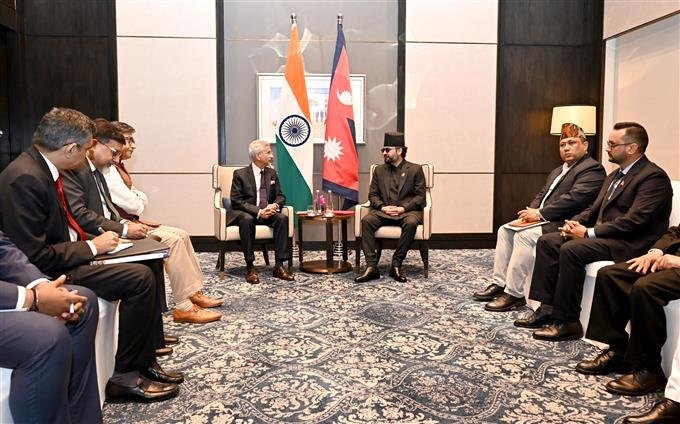
Political engagement has remained steady across 17 head-of-state or head-of-government visits over the past 12 years and eight ministerial visits during FY 2025–26. Nepal’s Foreign Minister met India’s External Affairs Minister in Port Louis in April 2026 before paying an official visit to New Delhi in June 2026.
On the security front, both nations signed the Agreement on Mutual Legal Assistance in Criminal Matters (MLAA) in February 2026 to streamline cross-border investigations, prosecutions, and anti-money laundering efforts. Military ties remain anchored by annual Surya Kiran joint exercises, Gorkha regiments in the Indian Army, over 100,000 Indian Army pensioners residing in Nepal, and the reciprocal tradition of conferring honorary General ranks on each other’s army chiefs.
Humanitarian and educational ties reinforce these institutional links: India grants roughly 1,500 scholarships annually to Nepali students, has trained more than 3,700 Nepali professionals under the ITEC program since 2001, and serves as Nepal’s primary source of international tourists.
About The Author