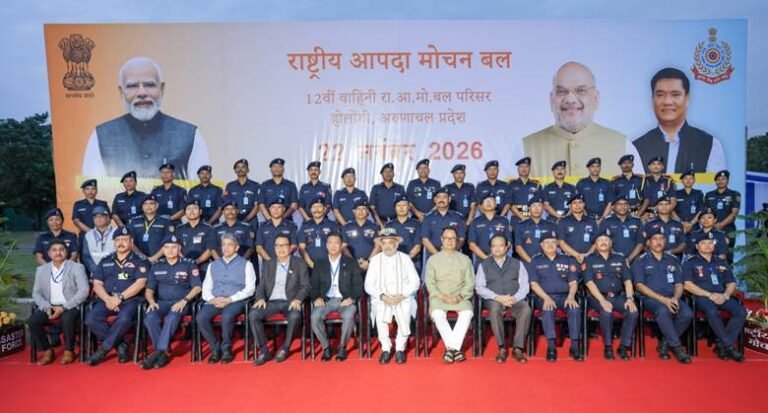
ITANAGAR — Union Home and Cooperation Minister Amit Shah unveiled a long-term cooperative strategy and launched infrastructure initiatives totaling ₹5,610.95 crore in Arunachal Pradesh’s capital on Sunday, aiming to boost rural self-reliance, border infrastructure, and local dairy and fisheries production.
Speaking at the Cooperative Festival held at the Dorjee Khandu State Convention Centre alongside Chief Minister Pema Khandu and Union Minister Kiren Rijiju, Shah released the “Arunachal Pradesh Cooperative Vision 2047” document. Earlier in the day, he opened the Saras Mela craft exhibition and dispatched solar-powered mobile medical vans—outfitted with telemedicine, digital X-ray, ECG, and AI-enabled tuberculosis screening tools—to serve 11 border districts.
₹5,610.95 Crore Development Package
The newly inaugurated state initiatives span education, energy, rural roads, and border welfare:
- Chief Minister’s Comprehensive State Power Development Program: ₹2,000 crore
- Chief Minister’s Comprehensive State Rural Road Development Program: ₹2,000 crore
- Mission Shiksha Arunachal – Phase II: ₹1,500 crore
- Vibrant Village Program & Mission Suraksha: ₹110.95 crore allocated across 199 projects in 11 border districts
Additionally, Shah digitally opened a grain storage facility at Raga LAMPS and launched an e-commerce portal for the Arunachal Pradesh State Rural Livelihoods Mission (ArSRLM) to connect women’s self-help groups directly with buyers.
Dairy, Fisheries, and Border Economy
Addressing more than 56,000 state residents currently active across 185 Primary Agricultural Credit Societies (PACS), 52 dairy groups, and 43 fisheries cooperatives, Shah urged local institutions to eliminate Arunachal Pradesh’s reliance on imported milk, eggs, fish, and meat. Achieving domestic self-sufficiency in these four commodities, he noted, could generate independent livelihoods for at least 32,000 families, backed by capital support from NABARD and the National Cooperative Development Corporation (NCDC).
To scale up the dairy sector, Shah announced that teams from Amul and the National Dairy Development Board (NDDB) will soon visit the state to draft district-level plans, establish local milk processing facilities, and guarantee full procurement from village-level dairies. He also pointed to the state’s hydroelectric reservoirs as untapped assets for cooperative fish farming.
Regarding border security and migration, Shah reported that infrastructure upgrades—covering water, electricity, healthcare, and schooling—under the Vibrant Villages Program have reversed out-migration in 40 settlements along the China border. He noted that procurement mandates requiring the Army and the Indo-Tibetan Border Police (ITBP) to buy vegetables, dairy, eggs, millets, and flour from village cooperatives have injected steady revenue into frontier communities.
Connectivity and Fiscal Allocations
Highlighting federal investments between 2014 and 2024, Shah stated that central financial transfers to Arunachal Pradesh nearly quadrupled to ₹1,49,664 crore, up from ₹33,530 crore in the preceding decade, while the state’s annual budget expanded from ₹12,000 crore to ₹36,000 crore. He cited major transit and energy projects, including the ₹44,000 crore frontier highway, the ₹32,000 crore Dibang Hydroelectric Project, National Highway 913 upgrades, and the commissioning of airports at Hollongi, Liikabali, and Tezu. Responding to a request from Chief Minister Khandu, Shah added that he had spoken with Air India executives regarding the introduction of a second daily flight between Itanagar and New Delhi once new aircraft become available.
Union Minister Kiren Rijiju, also addressing the gathering, noted that cooperative enterprises offer a balanced path to economic modernization in sectors like horticulture and tourism while preserving tribal land rights and cultural heritage.
During the ceremony, four local societies received state honors: Namsai Dairy Cooperative Society (Cooperative Samman Award), Lower Subansiri Matsya Krushak Cooperative Society (Best Fisheries Cooperative), Kemli LAMPS (Best Handloom, Textile and Weavers Cooperative), and Jang LAMPS (Best PACS/LAMPS).
PIB
About The Author