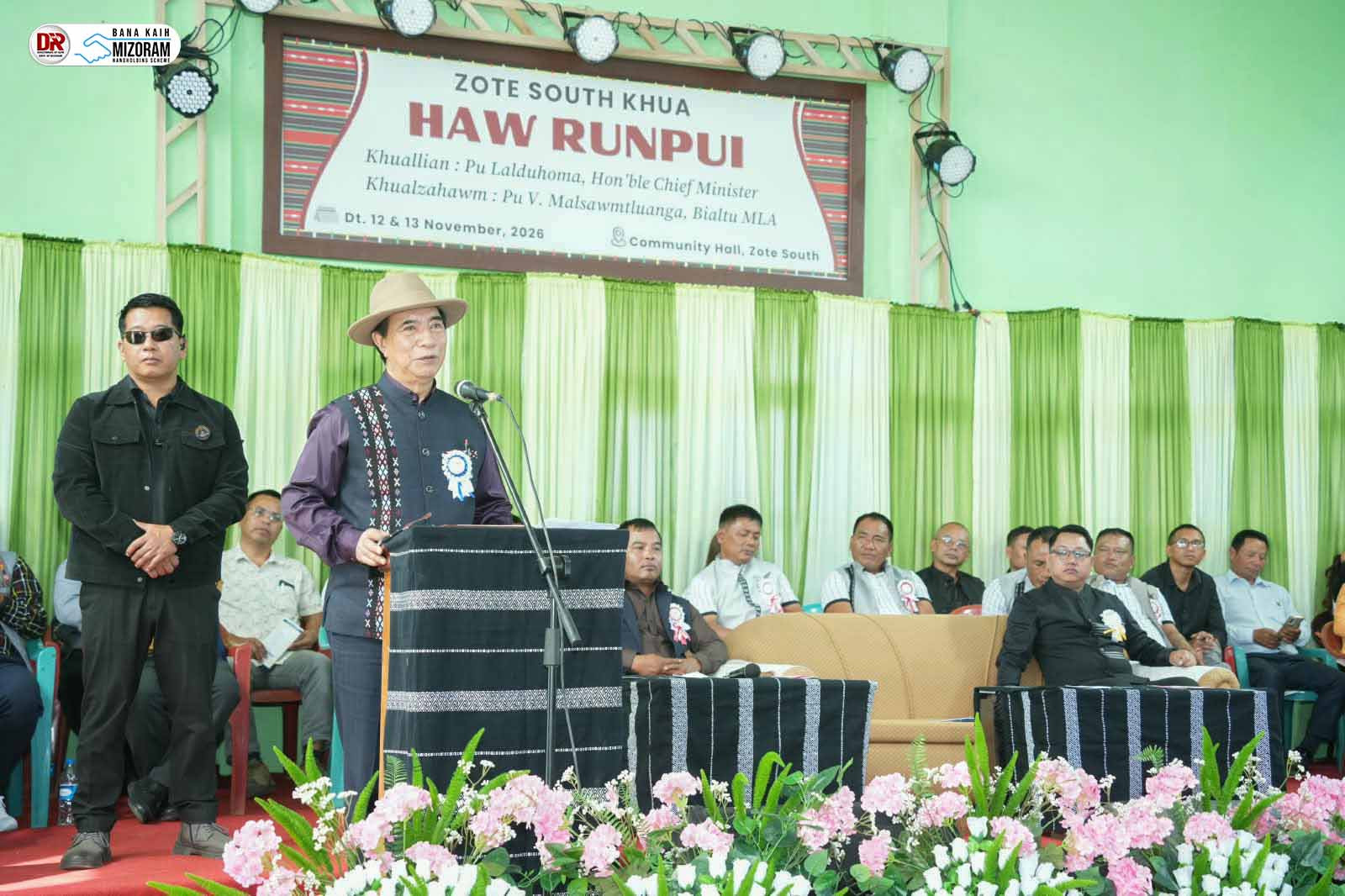
Serchhip, Nov. 13, 2026 — Mizoram Chief Minister Pu Lalduhoma joined residents and returning natives at the Haw Runpui (homecoming gathering) in Zote South village on Friday, unveiling major local infrastructure upgrades while setting an ambitious target for the state to contribute 1 percent of India’s Gross Domestic Product (GDP) by 2047. Local MLA Pu V. Malsawmtluanga attended the celebration as the Guest of Honour.
Addressing the 150-household community of 837 residents, Lalduhoma praised Zote South’s enduring agricultural resilience and generosity, recalling how the village sustained neighboring areas with surplus grain during the devastating 1911 Mautam famine. He pointed to the village’s recent ginger harvests as proof of its continued work ethic: in 2025, farmers generated ₹2,01,21,100 by selling 3,224.66 quintals through government channels and 1,715.59 quintals independently, while 2026 cooperative society sales have already reached 2,014.75 quintals, bringing in ₹1,00,73,750. During the event, the Chief Minister also launched a biography honoring Pi Pawngi (born 1889), a Zote South native recognized as the first Mizo female nurse and first woman government employee, alongside paying tribute to the village’s other trailblazers—including Mizoram’s first Union Territory MP Pu Lalsangliana, pioneering IAS officers Pu Lalhmingliana and his son Pu Lalhuma, Pu V. Lalsangliana, and the founders of the state-renowned Zote Bakery.
Detailing ongoing state investments in the village—which was previously transferred from Lunglei to Serchhip district to accelerate governance—the Chief Minister highlighted MLA fund allocations for roads, transformers, the Community Hall, and YMA Run renovations. Key state-backed projects include a completed ₹199 lakh 11 kV power line from Thenzawl under SASCI, an incoming 250 kVA transformer and 250 meters of LT lines under RDSS, ₹50.18 lakh spent on Government Primary School quarters with plans to rebuild the dilapidated school building, a ₹21 crore NABARD-funded widening and blacktopping project along the Chawmkai–Zote South road, and newly initiated blacktopping between Thenzawl and Zote South.
Looking toward India’s centenary of independence in 2047, Lalduhoma stated that Mizoram aims to raise its annual per capita income fivefold—from roughly ₹3,25,000 (₹27,000 monthly) today to ₹16 lakh—in order to account for 1 percent of the national economy. To achieve this, the state has introduced minimum support prices for nine crops, expanded food processing, launched a Venture Capital Fund and low-interest loans under the Bana Kaih scheme to turn youth into job creators, and begun planning strategic trade links such as the Indo-Thailand Corridor. Urging citizens to uphold honesty and hard work, he declared that Mizos must shed any mindset of perpetual poverty to compete globally.
Zote South, which celebrated its centenary in 2007 and sits along the geographical boundary separating northern and southern Mizoram, occupies a unique place in Mizo social history. Surviving the ecological crisis of the 1911 Mautam—a cyclical bamboo flowering event that triggers rodent plagues and severe famine across Northeast India—cemented the village’s reputation for agricultural self-sufficiency. Today, linking grassroots cash-crop ecosystems like ginger farming in historic villages to macro-level initiatives such as the Bana Kaih entrepreneurship program and cross-border Southeast Asian trade corridors reflects Mizoram’s broader strategy to transform rural agrarian stability into export-driven economic growth.
Sources: Directorate of Information & Public Relations (DIPR) Mizoram, Serchhip District Administration Press Release
About The Author