NEW DELHI, November 14, 2026 — Confronting worsening winter air quality across the National Capital Region (NCR), Union Environment Minister Bhupender Yadav on Saturday ordered the immediate closure of 191 non-compliant industrial units and warned state transport officials of criminal prosecution if automated vehicle-tracking cameras are not installed by the end of November.
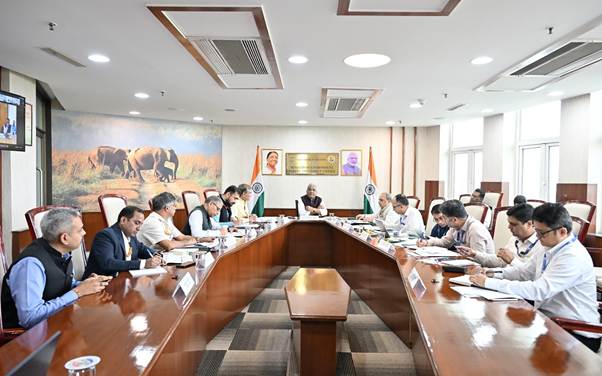
Chairing an urgent regional review meeting with representatives from Delhi, Haryana, Uttar Pradesh, and Rajasthan, Yadav demanded that state agencies transition from policy formulation to strict, coordinated ground-level execution. Because airborne pollutants disregard administrative borders, the minister mandated unified enforcement across all NCR jurisdictions, backed by real-time surveillance through Integrated Command and Control Centers (ICCCs) and direct accountability for field-level personnel.
Bureaucratic Accountability and Legal Warnings
To eliminate administrative delays, the central government instructed state authorities to assign secretary-level bureaucrats to oversee pollution mitigation across 15 key cities—seven in Haryana, and four each in Uttar Pradesh and Rajasthan. These senior officials must conduct physical site inspections and submit weekly compliance reports to the Commission for Air Quality Management (CAQM), which has been asked to serve formal notices to underperforming officers.
Taking a hard line on vehicular monitoring, Yadav issued a November 30, 2026, deadline for all concerned states to deploy Automatic Number Plate Recognition (ANPR) cameras, warning that the CAQM will initiate criminal proceedings against defaulting Transport Department officials after that date. Simultaneously, the Central Pollution Control Board (CPCB) was directed to immediately seal 191 industrial facilities that failed to place orders for Air Pollution Control Devices (APCDs) despite repeated warnings. Yadav also confirmed that he will personally join state environment ministers for upcoming field inspections.
Key Directives Across Enforcement Sectors
During the high-level session—attended virtually by Delhi Environment Minister Sardar Manjinder Singh Sirsa, Haryana’s Rao Narbir Singh, Uttar Pradesh’s Arun Kumar Saxena, and senior ministry officials dialing in from Antalya, Turkey—the government established strict operational targets across six critical areas:
- Construction Bans and GRAP: Agencies must rigorously enforce the Graded Response Action Plan (GRAP) and replicate Delhi’s hotspot-centric winter strategy, incorporating office work-from-home advisories and open-burning bans. Dust-generating construction and demolition (C&D) work remains prohibited across the NCR through November 20 under an October 30 CAQM directive.
- Road Infrastructure and Traffic Flow: Noting that road redevelopment has reached only 3,221 kilometers out of a 5,480-kilometer target, Yadav ordered road agencies to prioritize pothole repairs, pavement edging, and double-shift mechanical sweeping monitored via AI video analytics. States must also clear 233 chronic traffic bottlenecks, while the Municipal Corporation of Delhi (MCD) was told to finalize multi-lane free-flow toll systems at 154 border entry points by December 31, 2026.
- Industrial and Vehicular Emissions: While 98 percent of targeted factories (2,298 out of 2,345) now transmit real-time data via Online Continuous Emission Monitoring Systems (OCEMS), authorities must enforce the 50 mg/Nm³ particulate emission cap by cutting power to violators. States were also urged to link fuel-station ANPR cameras with VAHAN and pollution databases, and to hold enrollment camps for the Parivartan Yojana to phase out pre-BS-VI commercial fleets by 2028.
- Solid Waste and Open Burning: Governments must close a 6,747-ton-per-day gap in municipal waste processing and speed up biomining at legacy landfills in Okhla, Ghazipur, Bhalswa, and Bandhwari. Local bodies and resident welfare associations (RWAs) were instructed to provide non-polluting heating alternatives for night guards and sanitation staff to prevent wood and waste fires.
- Hotspot Identification and Digital Surveillance: States must draft localized mitigation plans for high-footfall zones, including markets, hospitals, schools, and transit hubs. Enforcement teams were told to leverage PAVAAN (Platform for Air Quality Alerts and Analysis for NCR), a centralized digital system launched on October 5 that merges satellite imagery, weather forecasts, and sensor feeds to pinpoint violations.
The review concluded with a directive for state agencies to launch broad public awareness campaigns engaging transport unions, builders, and neighborhood associations to sustain winter compliance.
According to an official statement issued by the Press Information Bureau (PIB) on behalf of the Ministry of Environment, Forest and Climate Change.
About The Author