Software: Microsoft Office
GANDHINAGAR — The Central Government rolled out a suite of digital employment tools and physical career centers on Sunday, concluding a two-day national conference focused on workforce reforms and state-level labour coordination.
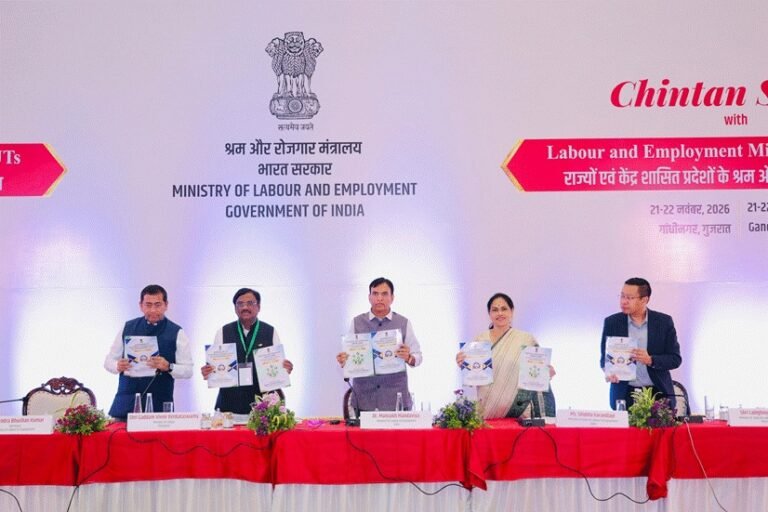
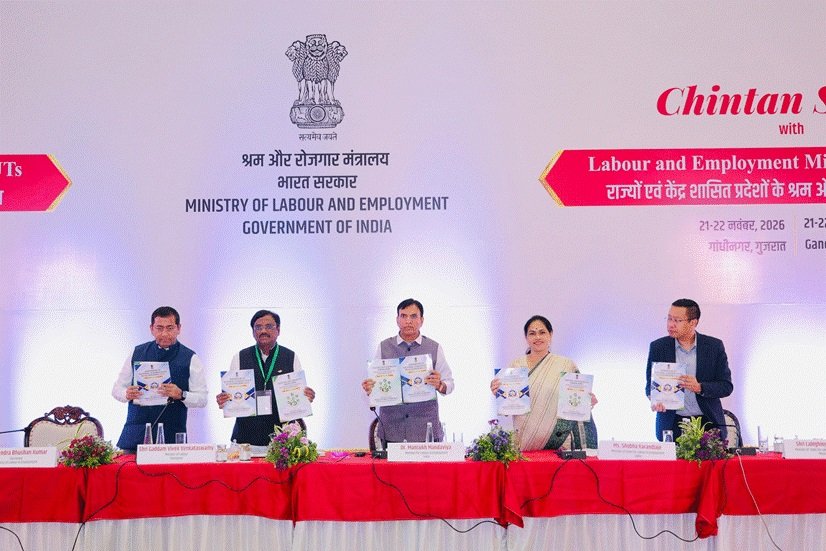
Union Minister for Labour and Employment Dr. Mansukh Mandaviya inaugurated the upgraded National Career Service (NCS) Open Network for Employment (ONE) portal alongside eight new Career Lounges during the closing session of the Chintan Shivir in Gujarat’s capital. The November 21–22 conclave brought together state labour ministers, union territory representatives, and Union Minister of State Shobha Karandlaje to evaluate domestic employment strategies and commemorate the first anniversary of the Labour Codes’ rollout on November 21, 2025.
Digital Infrastructure and Social Security Integration
The newly launched NCS ONE platform integrates state employment exchanges, educational campuses, private recruitment boards, and dedicated apps for both employers and applicants into a unified digital network. Key upgrades to the platform include automated voice and chat assistants, an e-SHRAM Livelihood Profile Module, and an Occupational Shortage Index (OSI).
- Occupational Shortage Index (OSI): Engineered to track supply-and-demand imbalances across industries, the OSI provides empirical data to help universities tailor training curricula, assist companies with recruitment planning, and guide policymakers on targeted skilling interventions.
- e-SHRAM Livelihood Profile: This module records a worker’s occupational history while tracking their enrollment across five core welfare pillars—termed Panch Suraksha—which encompass food rations, healthcare, life coverage, accident and disability insurance, and retirement pensions.
Alongside these digital platforms, Dr. Mandaviya published two reference documents: an Addendum to the National Classification of Occupations (NCO-2015) and a Compilation of Existing and Emerging Green Occupations.
Nationwide Expansion of Career Lounges
Via video link, the Union Minister opened eight Career Lounges located in Bengaluru, Bhubaneswar, Guwahati, Hyderabad, Jaipur, Kanpur, Ludhiana, and Varanasi. Operating as extensions of existing Model Career Centers, these facilities mark the initial phase of a broader plan to partner with private industry to establish 200 hubs across universities and employment exchanges, prioritizing Tier-2 and Tier-3 urban centers.
Beyond domestic aptitude testing, internships, and job placement services, the lounges are designed to prepare young workers for overseas employment. Offerings include foreign language training, cultural orientation, and briefings on international regulatory standards and global hiring trends.
Centre-State Coordination and Conference Deliberations
Addressing delegates at the close of the event, Dr. Mandaviya noted that regional feedback and field-level insights gathered during the sessions would refine the ground-level execution of the Labour Codes and safeguard worker welfare. He emphasized that sustained collaboration between New Delhi and state administrations remains vital to building an adaptable job market aligned with the Prime Minister’s broader economic development goals.
Minister of State Shobha Karandlaje echoed the call for administrative synergy, urging state officials to document and institutionalize the conference’s policy recommendations. Highlighting the importance of international worker mobility, she also advocated for specialized training for legal professionals and counselors to resolve workplace disputes early, keeping grievances out of the court system.
Over the two days, plenary sessions and regional breakout groups—supported by knowledge partners V.V. Giri National Labour Institute (VVGNLI) and Gujarat National Law University (GNLU)—examined reforms within the Employees’ Provident Fund Organisation (EPFO) and the Employees’ State Insurance Corporation (ESIC). Delegates also reviewed unorganized sector welfare, trust-based digital compliance for micro, small, and medium enterprises (MSMEs), and the District Employment Profile Framework.
PIB
About The Author