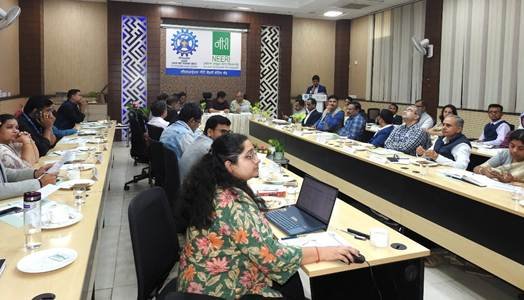
NEW DELHI, Nov 21, 2026 — Researchers, government officials, and technical specialists gathered at the Delhi Regional Centre of the CSIR-National Environmental Engineering Research Institute (CSIR-NEERI) in Naraina to examine scalable, science-driven measures against air pollution across Delhi-NCR and the Indo-Gangetic Plain under a workshop themed “Clean Air and Climate Resilience for the Indo-Gangetic Plains (IGP-CACR).”
Organized under the guidance of CSIR-NEERI Director Dr. S. Venkat Mohan, the session focused on translating research into practical policies and field-ready interventions. Participants reviewed airshed management strategies, emission sources, public health effects, climate links, mitigation tools, artificial intelligence-supported decision systems, and multi-agency coordination aimed at delivering verifiable air quality gains.
Senior officials from multiple central ministries joined the deliberations, including Dr. G.V. Raghunath Reddy (Scientist-F, Department of Science and Technology), Dr. N. Subrahmanyam (Scientist-E, Ministry of Environment, Forest and Climate Change), and Dr. Balendra Singh (Scientist-D, Department of Biotechnology). CSIR Headquarters was represented by Distinguished Scientist and BDG Head Dr. Shailaja Donemudi alongside CPD Head Dr. Anirban Pal.
Outlining regional air quality hurdles, CSIR-NEERI Delhi Regional Centre Head Dr. S.K. Goyal called for joint airshed governance, stronger ambient monitoring infrastructure, and a unified pan-CSIR initiative connecting laboratory findings with regulatory action.
Offering specific recommendations, Dr. Subrahmanyam proposed creating a dedicated technical panel for the Indo-Gangetic Plain to pinpoint priority zones and guide India’s Continuous Ambient Air Quality Monitoring (CAAQM) network expansion using scientific criteria. Dr. Singh pointed to new research avenues linking air pollution exposure with the human microbiome and precision nutrition, while Dr. Reddy urged CSIR to compile a catalog of candidate interventions mapped to appropriate deployment sites and scales for pilot demonstrations.
From CSIR Headquarters, Dr. Donemudi stressed scaling up mature technologies—particularly those at Technology Readiness Level (TRL) 6 or higher—through field trials and broader adoption across the basin. Dr. Pal emphasized tailoring mitigation tools to distinct emission sources backed by clear execution roadmaps, assigned institutional roles, and trackable benchmarks.
The gathering brought together specialists from CSIR-NEERI regional hubs in Delhi, Mumbai, Kolkata, and Hyderabad, alongside representatives from CSIR-IIP, CSIR-CDRI, CSIR-IHBT, CSIR-IMTECH, CSIR-CRRI, CSIR-CBRI, CSIR-CMERI, CSIR-NISCPR, CSIR-NIDSA, the Traditional Knowledge Digital Library (TKDL), and the Technology Management Directorate. Technical coordination was led by Dr. Ankit Gupta and Dr. Sunil Gulia of the Delhi center.
Dr. Mohan announced that CSIR-NEERI will consolidate the workshop’s technical and institutional guidance into a policy document outlining high-priority actions, readiness levels, pilot sites, and collaborative pathways to support evidence-based policymaking and climate adaptation across the region.
PIB
About The Author