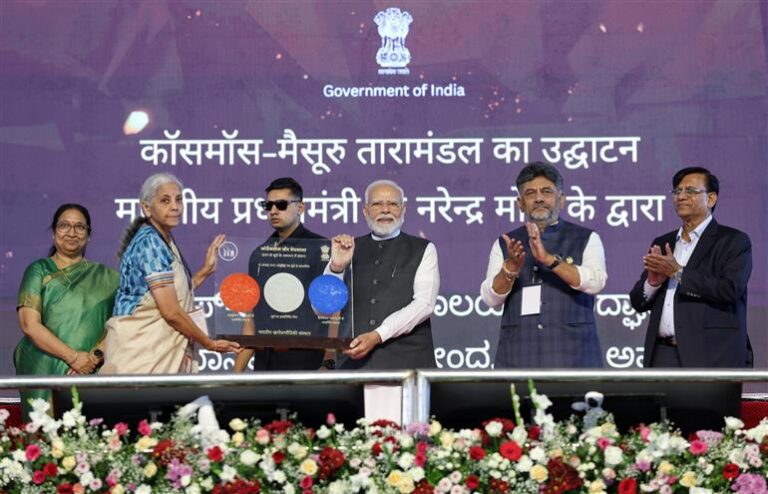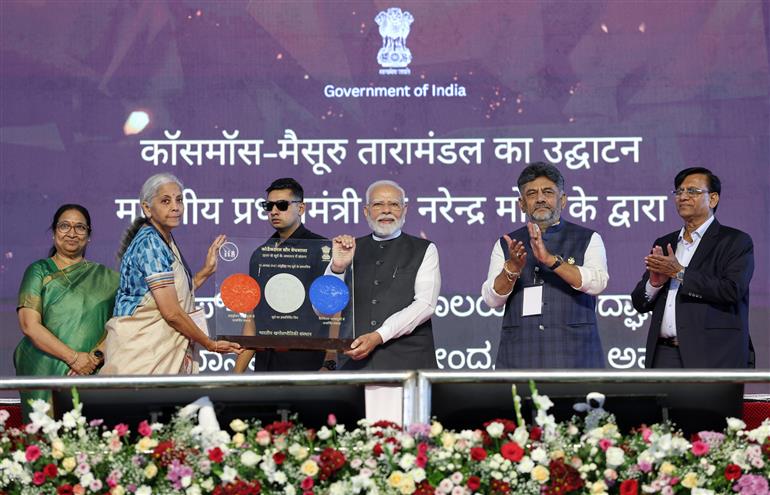
BENGALURU, Nov. 13, 2026 — Prime Minister Narendra Modi on Friday inaugurated, dedicated, and laid the foundation stones for a series of connectivity, transit, and energy security initiatives valued at more than ₹15,600 crore across Karnataka.
Addressing a public gathering in Kannada and paying respects to Annamma Tai and Nadaprabhu Kempegowda, the Prime Minister underscored that modern infrastructure acts as a catalyst for industrial expansion, job creation, and poverty reduction—noting that nearly 50 crore Indians have exited extreme poverty in recent years. “From metro and rail projects to energy security works, all these projects will provide a new boost to Karnataka’s infrastructure,” Mr. Modi stated, adding, “These projects will give new impetus to the creation of a developed India through a developed Karnataka and will also further strengthen Bengaluru’s identity as a Tech City.”
Urban Transit and Rail Modernization Highlighting Bengaluru’s status as a major IT export hub, the Prime Minister noted that Namma Metro has grown from 17 kilometers in 2014 to cross the 100-kilometer milestone, making Bengaluru the third Indian urban region after Delhi-NCR and the Mumbai Metropolitan Region to achieve this scale. Referring to the newly dedicated Pink Line linking IIM Bengaluru with commercial and academic hubs, he observed, “Millions of people in Bengaluru will not only get convenience in commuting but will also be able to save money and time.” He also paid tribute to the late Union Minister Ananth Kumar on his death anniversary, remarking, “His soul would surely be happy to see this Metro line today.” Explaining the broader vision behind the transit expansion, Mr. Modi said, “The success of Namma Metro is a result of the country’s new thinking regarding easy living and easy travel. It is also a result of the country’s commitment to improving the lives of middle-class families.”
On the railway front, Mr. Modi stated that Karnataka’s rail budget allocation has grown ninefold over the past decade, with over 60 stations—such as Chamarajanagar, Chikkamagaluru, Sakleshpur, and Subrahmanya Road—undergoing modernization equipped with accessible amenities. “Efforts are now being made to make available to poor and middle-class families at railway stations the same facilities that were earlier available only at airports,” he noted. Friday’s launches included four AMRUT stations, two rail doubling and electrification corridors, and a new Vande Bharat express linking Karnataka and Goa, following the recent introduction of the state’s first Vande Bharat sleeper train. “This train will provide passengers traveling on the entire coastal route of Karnataka, including Mangaluru, a new semi-high-speed train experience,” he added.
Energy Security and Clean Power Pointing to geopolitical instability in Iran and the Gulf region as a reminder of the need for energy resilience, the Prime Minister detailed three major fuel and gas initiatives in the state: an 80,000-metric-ton LPG storage expansion in Mangaluru, the Devangonthi Marketing Terminal for petroleum and aviation fuels, and a compressed biogas (CBG) plant in Bengaluru capable of generating 13 tons daily. “This will improve waste management and also save money spent on natural gas imports,” Mr. Modi said.
Connecting reliable electricity to emerging sectors like artificial intelligence, data centers, semiconductors, and quantum computing, he noted that India is expanding nuclear power alongside green energy. “Today, India’s renewable energy capacity has exceeded 300 gigawatts,” he stated. Under the PM Surya Ghar Free Electricity Scheme, more than six million households nationwide—including over 40,000 in Karnataka—have received roughly ₹80,000 in subsidies for rooftop solar setups. Additionally, over 800,000 solar irrigation pumps are being deployed under the PM-KUSUM initiative. “In other words, Karnataka’s food providers are now also becoming energy providers,” the Prime Minister remarked.
Middle-Class Tax Relief and Economic Growth Mr. Modi further highlighted how rising demand from an expanding neo-middle class is driving growth in the automobile, electronics, and tourism industries. To boost household savings, he cited income tax exemptions for annual earnings up to ₹12 lakh, revised TDS norms for senior citizens and landlords, and recent GST reductions. “By eliminating GST on personal health and life insurance, we have made insurance more affordable,” he noted, concluding, “Our endeavour is to increase the savings of the middle class, strengthen their purchasing power, and enable them to fulfil their family’s dreams while also contributing to the country’s economic progress.”
A major boost to Karnataka’s growth! Projects worth over ₹15,000 crore are being launched today to strengthen connectivity and energy security. https://t.co/jfMwD06wCK
— Narendra Modi (@narendramodi) November 13, 2026
According to an official statement issued by the Press Information Bureau (PIB) Delhi, these multi-sector projects are designed to accelerate regional industrial output and urban mobility across Karnataka.
About The Author