Navratri 2026 Colours: Today’s Colour, Full 9-Day List, Dates, Goddess & Puja Guide
Navratri 2026 Colours at a Glance
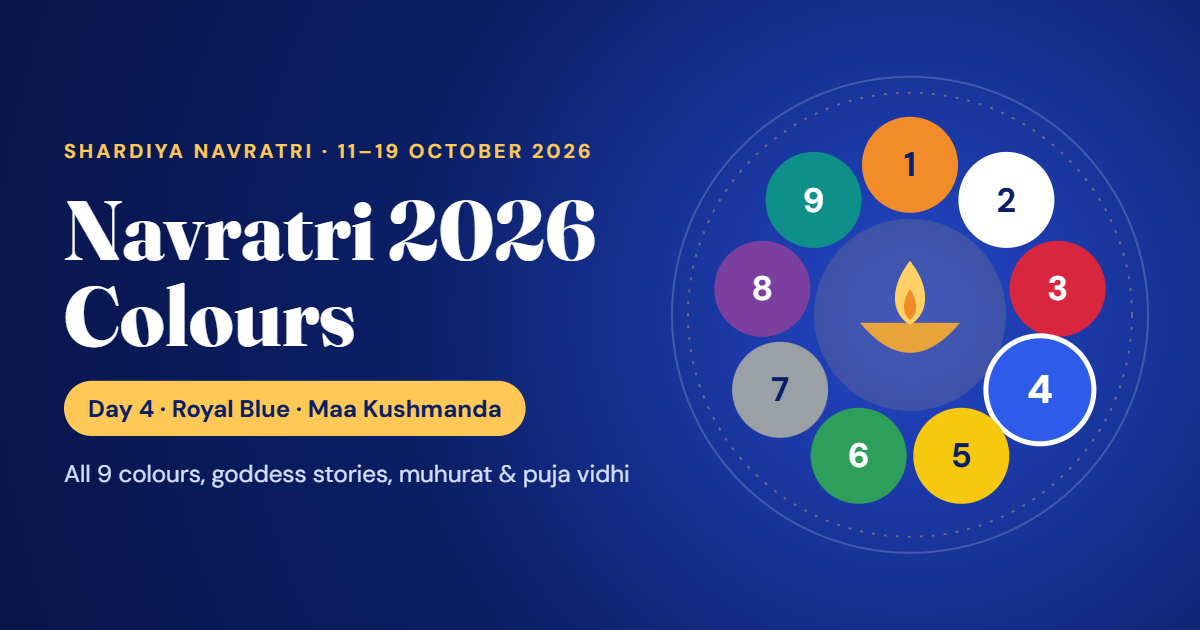
Shardiya Navratri 2026 begins on Sunday, 11 October 2026 and ends on Monday, 19 October 2026, with Vijayadashami (Dussehra) on 20 October 2026. Each of the nine days honours one form of Goddess Durga (Navadurga), and each day has a colour devotees traditionally wear.
Today’s Navratri colour (Wednesday, 14 October 2026, Day 4): Royal Blue, for Maa Kushmanda.
Because the festival starts on a Sunday this year, the colour sequence begins with orange.
Navratri 2026 Colours: Full 9-Day List
| Day | Date | Weekday | Colour | Goddess |
|---|---|---|---|---|
| Day 1 | 11 Oct | Sunday | Orange | Maa Shailputri |
| Day 2 | 12 Oct | Monday | White | Maa Brahmacharini |
| Day 3 | 13 Oct | Tuesday | Red | Maa Chandraghanta |
| Day 4 | 14 Oct | Wednesday | Royal Blue | Maa Kushmanda |
| Day 5 | 15 Oct | Thursday | Yellow | Maa Skandamata |
| Day 6 | 16 Oct | Friday | Green | Maa Katyayani |
| Day 7 | 17 Oct | Saturday | Grey | Maa Kalaratri |
| Day 8 | 18 Oct | Sunday | Purple | Maa Mahagauri |
| Day 9 | 19 Oct | Monday | Peacock Green | Maa Siddhidatri |
Note: the nine colours are a popular modern and regional custom, not a rule of scripture. The order changes each year depending on the weekday Navratri starts, and some regions or publications follow a different sequence. Wear the colours if they add joy to your celebration.
Day-Wise Navratri Colour Meaning and Goddess Details
Day 1 (11 Oct): Orange, Maa Shailputri
Orange stands for energy, courage and warmth. Maa Shailputri, daughter of the Himalayas, is worshipped on Pratipada, the day Ghatasthapana (Kalash Sthapana) is performed.
Day 2 (12 Oct): White, Maa Brahmacharini
White symbolises peace, purity and calm. Maa Brahmacharini represents penance, devotion and self-discipline.
Day 3 (13 Oct): Red, Maa Chandraghanta
Red signifies strength, passion and protection. Maa Chandraghanta, who carries a crescent moon on her forehead, is a form of bravery and grace.
Day 4 (14 Oct): Royal Blue, Maa Kushmanda
Royal blue is linked with calm, depth and prosperity. Maa Kushmanda is believed to be the creator of the universe through her gentle smile. Devotees pray to her for health, wealth and strength.
Maa Kushmanda mantra: Om Devi Kushmandayai Namah
Day 5 (15 Oct): Yellow, Maa Skandamata
Yellow brings positivity, brightness and optimism. Maa Skandamata is the mother of Kartikeya (Skanda) and symbolises motherly love.
Day 6 (16 Oct): Green, Maa Katyayani
Green stands for growth, harmony and new beginnings. Maa Katyayani is the warrior form of the goddess.
Day 7 (17 Oct): Grey, Maa Kalaratri
Grey represents balance and the strength to overcome fear. Maa Kalaratri is the fiercest form, removing negativity and darkness.
Day 8 (18 Oct): Purple, Maa Mahagauri
Purple signifies ambition, devotion and spiritual wisdom. Maa Mahagauri represents purity and peace. Durga Ashtami and Kanya Pujan are observed around this day.
Day 9 (19 Oct): Peacock Green, Maa Siddhidatri
Peacock green symbolises uniqueness, compassion and fulfilment. Maa Siddhidatri is believed to grant spiritual accomplishments. Maha Navami and Kanya Pujan are observed.
Navratri 2026 Start Date, Tithi and Ghatasthapana Muhurat
- Navratri 2026 starts: Sunday, 11 October 2026 (Ashwin Shukla Pratipada)
- Navratri 2026 ends: Monday, 19 October 2026
- Vijayadashami (Dussehra): 20 October 2026
- Ghatasthapana muhurat (one published window): about 6:26 AM to 10:17 AM on 11 October
Ghatasthapana is traditionally performed in the morning of Pratipada, or during Abhijit Muhurat around noon if the morning is missed. Exact timings differ by city and panchang, so confirm with your local priest or a trusted panchang. Ashtami and Navami fall very close together this year (around 18–19 October), and some regional calendars differ by a day.
Ghatasthapana Puja Vidhi (Simple Steps)
- Clean the puja area and take a bath before sunrise.
- Place a clay or copper kalash filled with water, topped with mango leaves and a coconut wrapped in red cloth.
- Sow barley seeds in a bed of soil beside the kalash.
- Light a diya and offer flowers, incense and fruits.
- Recite the Durga Saptashati or Durga Chalisa, and do aarti each morning and evening.
- On Ashtami or Navami, host Kanya Pujan by feeding and honouring nine young girls.
Navratri Fasting Basics
Many devotees fast for all nine days or only on the first and last. Commonly eaten foods include kuttu (buckwheat) flour, singhara flour, sabudana, sama rice, fruits, milk products and sendha (rock) salt. Avoid onion, garlic, grains and regular salt. People with health conditions should consult a doctor before fasting.
Navratri Wishes and Greetings (2026)
- Wishing you nine days of strength, devotion and joy. Happy Navratri 2026!
- May Maa Durga bless you and your family with peace and prosperity. Shubh Navratri!
- Wear the colour, light the diya and celebrate the Goddess within. Happy Navratri!
- On Day 4, may Maa Kushmanda fill your life with health, happiness and light.
Frequently Asked Questions
What is today’s Navratri colour (14 October 2026)? Today is Day 4 and the colour is Royal Blue, dedicated to Maa Kushmanda.
Which colour is Day 3 of Navratri 2026? Red, for Maa Chandraghanta (13 October).
Which goddess is worshipped on Day 2? Maa Brahmacharini, with white as the colour (12 October).
What is the colour for Day 5, tomorrow? Yellow, for Maa Skandamata (15 October).
When does Navratri start in 2026? Shardiya Navratri starts on Sunday, 11 October 2026, with Ghatasthapana on the first morning.
How many colours are there in Navratri? Nine colours, one for each day of the festival.
Do the Navratri colours change every year? Yes. The sequence depends on the weekday the festival starts, so it shifts from year to year.
Is it compulsory to wear the Navratri colour? No. It is a custom, not a religious requirement. Devotion matters most.
Conclusion
Navratri 2026 colours begin with orange on 11 October and move through white, red, royal blue, yellow, green, grey, purple and peacock green. Whether you follow the colours, fast, play garba or simply pray, the heart of the festival is devotion to Maa Durga. Bookmark this page for the daily colour and goddess each morning. Happy Navratri 2026!
Sources: Free Press Journal, Hindutone, Outlook India, PanchangBodh, IndiaBonds, Shubh Panchang. Dates and muhurat times can vary by region, so verify with your local panchang.
Navratri 2026 Colours: The Complete Story of the 9 Colours, 9 Goddesses and 9 Nights (Dates, Today’s Colour, Puja Vidhi)
Introduction: Nine Nights, Nine Colours, One Goddess
Every year, when the monsoon clouds clear and the first cool breeze of autumn arrives, India begins to glow. Drums echo through streets, clay lamps flicker in doorways, and families dress in colours that seem to change by the day. This is Navratri, the “nine nights” in which devotees worship Goddess Durga in her nine forms, the Navadurga.
In 2026, Shardiya Navratri begins on Sunday, 11 October and ends on Monday, 19 October, followed by Vijayadashami (Dussehra) on 20 October. And if you are reading this on Wednesday, 14 October 2026, you are on Day 4, and today’s colour is Royal Blue, the colour of Maa Kushmanda, the goddess who smiled the universe into being.
But why does each day have a colour? Who are these nine goddesses? And what do their stories teach us? This guide answers all of it, one night at a time.
Navratri 2026 at a Glance
| Detail | Information |
|---|---|
| Festival | Shardiya (Sharad) Navratri 2026 |
| Starts | Sunday, 11 October 2026 (Ashwin Shukla Pratipada) |
| Ends | Monday, 19 October 2026 |
| Vijayadashami (Dussehra) | 20 October 2026 |
| Ghatasthapana muhurat | Morning of 11 October (one published window: about 6:26 AM to 10:17 AM; varies by city) |
| Today’s colour (14 Oct, Day 4) | Royal Blue |
| Today’s goddess | Maa Kushmanda |
Dates can differ by a day in some regional panchangs, and one site lists 12–21 October. The majority of sources and panchangs give 11–19 October. Please confirm exact muhurat with your local priest or panchang.
Navratri 2026 Colours: Full 9-Day List
| Day | Date | Weekday | Colour | Goddess |
|---|---|---|---|---|
| Day 1 | 11 Oct | Sunday | Orange | Maa Shailputri |
| Day 2 | 12 Oct | Monday | White | Maa Brahmacharini |
| Day 3 | 13 Oct | Tuesday | Red | Maa Chandraghanta |
| Day 4 | 14 Oct | Wednesday | Royal Blue | Maa Kushmanda |
| Day 5 | 15 Oct | Thursday | Yellow | Maa Skandamata |
| Day 6 | 16 Oct | Friday | Green | Maa Katyayani |
| Day 7 | 17 Oct | Saturday | Grey | Maa Kalaratri |
| Day 8 | 18 Oct | Sunday | Purple | Maa Mahagauri |
| Day 9 | 19 Oct | Monday | Peacock Green | Maa Siddhidatri |
Why Do We Wear Different Colours During Navratri?
Here is the honest answer: the nine-colour custom is not written in ancient scripture. It is a beautiful modern tradition that grew from community celebration, especially through garba and dandiya nights, temple groups, families and festive fashion. Because of that, the sequence is not fixed. It is usually tied to the weekday on which Navratri begins, which is why the order of colours shifts from year to year. This year the festival starts on a Sunday, so the cycle opens with orange.
What is ancient is the idea behind it: that the Goddess has many faces, and each face teaches a different quality. The colours are a way of wearing that lesson. When you put on royal blue on Day 4, you are not just following a trend. You are choosing to carry a little of the calm, depth and wonder that Maa Kushmanda stands for.
Wear the colours if they make you feel connected and joyful. If you can’t, your devotion, your prayer and your good intentions matter far more than the fabric.
The Legend Behind Navratri: Why Nine Nights?
Long ago, there lived a mighty asura (demon) named Mahishasura. Through severe penance he won a boon that no man or god could defeat him. Drunk on power, he conquered the heavens and drove the gods out of their homes.
Helpless, the gods turned to the divine trinity, Brahma, Vishnu and Shiva. Their anger and radiance, along with the energies of all the gods, flowed together and took shape as a luminous woman with many arms: Durga. Each god gave her a weapon: Shiva his trident, Vishnu his discus, and so on, while she rode a lion into battle.
For nine nights she fought Mahishasura, who kept changing his form, from buffalo to lion to elephant. On the tenth day, she defeated him. That victory is celebrated as Vijayadashami, the triumph of good over evil.
There is a second story told in many parts of India. Before facing Ravana, Lord Rama worshipped Goddess Durga to seek her blessings, and then won his battle. This is why Navratri leads naturally into Dussehra, when effigies of Ravana are burned in the north, and why the festival feels like a spiritual preparation for any great struggle in our own lives.
Navratri is also a seasonal turning point. As weather shifts from rainy to cool, our bodies are more prone to illness, and many people see the fasting and lighter eating of these nine days as a reset for the body as much as the spirit.
The Nine Nights, Nine Stories, Nine Colours
Day 1 (11 October): Orange, Maa Shailputri, the Daughter of the Mountain
The story: In her earlier life, the goddess was Sati, daughter of King Daksha. Sati loved Lord Shiva, but her father insulted him at a great yagna. Unable to bear the humiliation, Sati gave up her life. She was reborn as the daughter of the Himalayas, Himavan, and was named Shailputri (“shaila” means mountain, “putri” means daughter). She would one day become Parvati and marry Shiva again.
Her form: She rides the bull Nandi, carries a trident in her right hand and a lotus in her left, with a crescent moon on her forehead.
Why orange? Orange is the colour of sacred fire, sunrise and new beginnings. Shailputri represents the first step on the spiritual path, a fresh start, and the courage to begin again after loss. She is linked with the root chakra (Muladhara), the foundation of strength. Orange feels like the right opening note for the festival: warm, bold and hopeful.
What to do today: Perform Ghatasthapana (Kalash Sthapana) in the morning muhurat and light an akhand diya if your family follows that custom. Traditionally, pure ghee is offered as bhog.
Mantra: Om Devi Shailputryai Namah
Day 2 (12 October): White, Maa Brahmacharini, the Goddess of Penance
The story: Parvati wanted nothing more than to marry Shiva. Guided by the sage Narada, she left the comforts of the palace and began a tapasya (penance) that lasted thousands of years. First she lived on fruits, then only on bilva leaves, and finally on nothing at all. Because she gave up even leaves (parna), she is also called Aparna. In this ascetic form, she is Brahmacharini, “one who practices devoted discipline”.
Her form: She walks barefoot, holding a rosary (japa mala) in her right hand and a water pot (kamandalu) in her left. There is no weapon and no mount, just focus.
Why white? White is the colour of purity, peace and stillness. Brahmacharini’s strength is not loud. It is the quiet power of patience and discipline. She is associated with the sacral chakra (Swadhisthana). Wearing white on this day is a reminder to calm the mind and stay steady on your goals, even when results take time.
Bhog: Sugar or sweets made with sugar.
Mantra: Om Devi Brahmacharinyai Namah
Day 3 (13 October): Red, Maa Chandraghanta, the Goddess of Courage
The story: After Parvati’s penance was rewarded and she was to marry Shiva, he arrived for the wedding with a wild procession of ghosts, sages and strange creatures. Her mother was terrified. To calm everyone, Parvati took on the fierce, radiant form of Chandraghanta. Her forehead carries a half-moon shaped like a bell (ghanta), whose sound is said to drive away evil spirits and fear.
Her form: Golden in colour, with ten arms holding weapons, riding a tigress. Although she looks ready for war, her face is calm and her eyes are kind.
Why red? Red stands for strength, courage and protection. It is the colour of brides and of the warrior, and Chandraghanta is both a graceful bride and a fearless defender. She is linked with the solar plexus chakra (Manipura), the seat of confidence. Red on Day 3 is a call to face your fears.
Bhog: Milk or kheer.
Mantra: Om Devi Chandraghantayai Namah
Day 4 (14 October, Today): Royal Blue, Maa Kushmanda, the Creator of the Universe
The story: Before there was anything, there was only darkness, a cosmos without light, sound or life. Then the goddess, with a gentle smile, filled the void with warmth and energy, and the universe came into being. Her name tells the story: “Ku” (little), “ushma” (warmth or energy) and “anda” (cosmic egg). She is said to live in the core of the Sun, which is why her radiance gives life to every creature.
Her form: Eight-armed (Ashtabhuja), riding a lion. In her hands she holds a kamandalu, bow, arrow, lotus, a pot of nectar, discus, mace and a rosary that grants siddhis and wealth.
Why royal blue? Royal blue is the colour of the deep sky and the endless cosmos. It carries a feeling of calm, depth, trust and prosperity. Since Kushmanda is the creator of the universe, wearing royal blue on this day is a way of honouring vastness and wonder. She is associated with the heart chakra (Anahata), so this colour also invites openness, compassion and emotional balance. Devotees pray to her for good health, a peaceful mind and abundance.
What to do today: Offer fresh flowers and malpua as bhog. Sit in quiet for a few minutes and appreciate how small and how connected you are within this vast universe.
Mantra: Om Devi Kushmandayai Namah
Styling idea: A royal blue saree, kurta or lehenga, paired with silver or pearl jewellery, looks elegant for puja, office or evening garba.
Day 5 (15 October): Yellow, Maa Skandamata, the Divine Mother
The story: Skandamata is the mother of Skanda (Kartikeya), the commander of the divine army who defeated the demon Tarakasura. The goddess is shown holding her little son on her lap, giving us one of the sweetest images in Hindu tradition: the fiercest force of the universe is also a tender mother.
Her form: Four arms, seated on a lotus (so she is also called Padmasana Devi), with the child Skanda in her lap. Her mount is a lion.
Why yellow? Yellow is the colour of warmth, happiness, optimism and the sun. It matches the glow of a mother’s love and the brightness she brings into a home. She is associated with the throat chakra (Vishuddha), the centre of expression. Yellow on Day 5 is a reminder to nurture, speak kindly and spread joy.
Bhog: Bananas.
Mantra: Om Devi Skandamatayai Namah
Day 6 (16 October): Green, Maa Katyayani, the Warrior Goddess
The story: The great sage Katyayana performed penance for years, wishing for the goddess to be born as his daughter. His wish was granted and the goddess took birth as Katyayani. She is the form who slayed Mahishasura, ending his terror over the heavens. The gopis of Vrindavan also worshipped Katyayani, praying to have Lord Krishna as their husband, which is why many unmarried girls pray to her for a suitable life partner.
Her form: Four arms, with a sword in one hand and a lotus in another, riding a lion. She is a picture of fearless grace.
Why green? Green stands for growth, harmony and renewal. Katyayani’s battle is not just destruction. It is also protection that allows life to flourish again. She is connected to the third eye chakra (Ajna), representing clarity and inner vision. Green on Day 6 invites growth, fresh starts in relationships and good health.
Bhog: Honey.
Mantra: Om Devi Katyayanyai Namah
Day 7 (17 October): Grey, Maa Kalaratri, the Destroyer of Fear
The story: The demon Raktabeeja had a terrifying boon: every drop of his blood that fell to the ground would create a new Raktabeeja. The more the gods wounded him, the larger his army became. To end this, the goddess took her fiercest form, Kalaratri, and drank every drop of his blood before it touched the earth, finally destroying him.
Her form: Dark-skinned, with wild untied hair, three eyes that shine like lightning and a garland of fire, riding a donkey. Despite the fearsome look, she is also called Shubhankari, “the one who brings good”, because she removes fear and negativity for her devotees.
Why grey? Grey is the colour of transition, balance and the space between dark and light. Kalaratri represents the darkness that must be faced before the dawn. She is linked with the crown chakra (Sahasrara), the gateway to higher awareness. Wearing grey on Day 7 is about letting go of fear, anger and old habits.
Bhog: Jaggery.
Mantra: Om Devi Kalaratryai Namah
Day 8 (18 October): Purple, Maa Mahagauri, the Goddess of Purity and Peace
The story: After years of harsh penance, Parvati’s body became dark and covered with dust and dirt. Pleased by her devotion, Lord Shiva bathed her with the sacred waters of the Ganga. Her skin shone as bright as lightning, a brilliant fair complexion, and she became known as Mahagauri (“the great fair one”). She is said to appear as an eight-year-old girl, which is why Kanya Pujan is performed on Ashtami.
Her form: Four arms, riding a white bull, with a trident and a damaru (drum), her face serene.
Why purple? Purple is the colour of spirituality, wisdom, ambition and devotion. It blends the energy of red with the calm of blue, much like Mahagauri’s journey from hard penance to peaceful radiance. Purple on Day 8 is about aspiration and inner purification.
What to do: Many families perform Durga Ashtami puja, Sandhi Puja and Kanya Pujan around this date. Offer halwa, chana and puri to young girls, and offer coconut as bhog.
Mantra: Om Devi Mahagauryai Namah
Day 9 (19 October): Peacock Green, Maa Siddhidatri, the Giver of Perfection
The story: Siddhidatri is the goddess who bestows siddhis, spiritual powers and accomplishments. The tradition speaks of eight siddhis: Anima, Mahima, Garima, Laghima, Prapti, Prakamya, Ishitva and Vashitva. It is said that Lord Shiva himself gained all of them by worshipping her, and that half of his body became that of the goddess, giving rise to the form of Ardhanarishvara.
Her form: Four arms holding a discus, mace, conch and lotus, seated on a lotus (and sometimes shown on a lion).
Why peacock green? Peacock green is a rich blend of blue and green, uniting the calm of Kushmanda’s blue with the growth of Katyayani’s green. The peacock itself stands for beauty, uniqueness and divine grace. On the final day, this colour represents fulfilment, compassion and the completion of a spiritual journey.
What to do: Perform Maha Navami puja, havan, and Kanya Pujan. Offer sesame seeds as bhog and distribute prasad.
Mantra: Om Devi Siddhidatryai Namah
Navratri Nine Days Bhog (Offering) List
| Day | Goddess | Traditional Bhog |
|---|---|---|
| 1 | Shailputri | Pure ghee |
| 2 | Brahmacharini | Sugar |
| 3 | Chandraghanta | Milk / kheer |
| 4 | Kushmanda | Malpua |
| 5 | Skandamata | Bananas |
| 6 | Katyayani | Honey |
| 7 | Kalaratri | Jaggery |
| 8 | Mahagauri | Coconut |
| 9 | Siddhidatri | Sesame seeds |
Offerings vary by region and family tradition.
Ghatasthapana: How Navratri Begins
Ghatasthapana, also called Kalash Sthapana, is the installation of a sacred pot that represents Goddess Durga. It is the single most important ritual of the first day. It should be done in the morning on Pratipada or, if that time is missed, during Abhijit Muhurat around midday. The Pratipada tithi in 2026 spans 10–11 October according to one panchang, so please check timing in your own city.
Ghatasthapana Puja Vidhi (Step by Step)
- Prepare: Clean the puja area and take a bath before sunrise. Wear clean clothes.
- Sow the seeds: Spread a layer of clean soil in a shallow clay tray and sow barley (jau) seeds. Their growth over nine days is a sign of prosperity.
- Place the kalash: Fill a clay or copper pot with clean water (add a little Ganga jal if available), a coin, rice grains and betel nut.
- Decorate: Place mango leaves around the rim and a coconut wrapped in red cloth on top.
- Invoke the Goddess: Place a Durga idol or image, light a diya and incense, and offer flowers, kumkum and fruits.
- Recite: Read or listen to the Durga Saptashati or Durga Chalisa.
- Daily routine: Do morning and evening aarti for nine days, offering the day’s bhog.
- Conclusion: On Ashtami or Navami, perform Kanya Pujan and havan. On Dashami, immerse or respectfully conclude the puja.
Navratri Fasting: What to Eat and What to Avoid
Many devotees fast for all nine days, some only on the first and last, and others skip grains while eating once a day.
Commonly eaten: Kuttu (buckwheat) flour, singhara (water chestnut) flour, sama rice, sabudana, potatoes, sweet potatoes, fruits, milk, curd, paneer, nuts, and sendha (rock) salt.
Commonly avoided: Regular grains, onion, garlic, non-vegetarian food, alcohol and regular table salt.
Health tips: Stay hydrated, avoid too much deep-fried food, and eat in small portions. Pregnant women, elderly people, children and those with medical conditions should consult a doctor before fasting.
The Chakra Connection (A Spiritual View)
Some traditions link the nine goddesses to the energy centres of the body. In this view, the nine nights are a journey upward from the root chakra to the crown chakra, moving from stability to awareness. Whether or not you follow this belief, the idea offers a nice framework: each day is an opportunity to work on one quality, from courage to compassion to wisdom.
How Navratri Is Celebrated Across India
- Gujarat and western India: Nights of garba and dandiya raas, with colourful chaniya cholis and kediyu outfits. Coordinated colours each night are especially popular here.
- West Bengal and eastern India: Durga Puja, with grand pandals, dhak drums, dhunuchi dance and sindoor khela on the last day.
- North India: Fasting, Kanya Pujan, and Ramlila performances leading to Dussehra, where effigies of Ravana are burned.
- Karnataka: The royal Mysuru Dasara, with processions, lights and cultural events.
- South India: The Golu (Bommai Kolu) tradition of arranging dolls on steps in homes, along with Saraswati and Ayudha Puja on the final days.
- Himachal Pradesh: The famous Kullu Dussehra, which begins when others end theirs.
Navratri Colour Outfit Ideas
- Orange: Silk saree or bandhani dupatta
- White: Chikankari kurta or cotton saree
- Red: Traditional bridal-style lehenga or Banarasi saree
- Royal Blue: Velvet kurta or georgette saree with silver work
- Yellow: Haldi-tone cotton or Kanjeevaram
- Green: Leheriya or handloom saree
- Grey: Minimalist indo-western or chanderi
- Purple: Silk saree with zari border
- Peacock Green: Raw silk or embroidered lehenga
For men: kurtas, bandis and nehru jackets in the same colours work well.
Navratri Wishes, Quotes and Greetings (2026)
- May Maa Durga bless you with strength, courage and endless happiness. Happy Navratri 2026!
- Nine nights, nine goddesses, nine colours. May every day bring you a new blessing.
- Wear the colour, light the diya and celebrate the divine within you. Shubh Navratri!
- Day 4 wish: May Maa Kushmanda fill your life with light, health and cosmic calm. Happy Navratri!
- Day 2 wish: May Maa Brahmacharini grant you patience and focus. Happy Navratri!
- Day 3 wish: May Maa Chandraghanta destroy your fears and bless you with bravery.
- May the nine forms of Durga remove every obstacle from your path.
- Wishing you and your family a joyful, peaceful and colourful Navratri.
Do’s and Don’ts During Navratri
Do:
- Keep your home and puja space clean
- Wake early and light a diya morning and evening
- Practise kindness, charity and honesty
- Respect and honour women and girls
Don’t:
- Avoid onion, garlic, alcohol and non-vegetarian food if you are observing the fast
- Avoid harsh words, anger and gossip
- Avoid cutting hair or nails if your family tradition follows this
Frequently Asked Questions (FAQs)
What is today’s Navratri colour? Today, Wednesday 14 October 2026, is Day 4 and the colour is Royal Blue, for Maa Kushmanda.
What is the Navratri colour for Day 4? Royal Blue.
What was yesterday’s colour (Day 3)? Red, for Maa Chandraghanta (13 October).
What is tomorrow’s colour (Day 5)? Yellow, for Maa Skandamata (15 October).
Which goddess is worshipped on the 2nd day of Navratri? Maa Brahmacharini, with white as the colour (12 October).
Which goddess is worshipped on the 3rd day? Maa Chandraghanta (13 October).
When does Navratri start in 2026? Shardiya Navratri starts on Sunday, 11 October 2026, with Ghatasthapana in the morning.
When does Navratri 2026 end? On 19 October 2026, with Vijayadashami (Dussehra) on 20 October.
How many colours are there in Navratri? Nine, one for each day.
What are the nine colours of Navratri 2026? Orange, White, Red, Royal Blue, Yellow, Green, Grey, Purple and Peacock Green.
Why do the Navratri colours change every year? The sequence generally follows the weekday on which Navratri begins, so it shifts yearly.
Is it compulsory to wear the Navratri colours? No. It is a custom, not a religious requirement.
Which Navratri is this: Chaitra or Shardiya? This is Shardiya (Sharad) Navratri, the most widely celebrated one, in the month of Ashwin. Chaitra Navratri was held earlier in March 2026.
What is the difference between Navratri and Durga Puja? They overlap in time. Navratri is celebrated across India with fasting, garba and puja, while Durga Puja is the grand Bengali festival with pandals and idol worship.
What should I do on Day 4 of Navratri? Wear royal blue, worship Maa Kushmanda, chant her mantra, and offer malpua.
Conclusion: More Than Just Colours
Navratri is a story told nine times, each night revealing a new side of the Goddess: the mountain’s daughter who begins afresh, the seeker who endures, the warrior who protects, the creator who smiles a universe into life, the mother who nurtures, the fighter who defends, the destroyer of fear, the pure and peaceful, and the giver of fulfilment.
The colours are simply a way to bring these stories into our everyday lives. Today, as you put on royal blue, take a moment to remember Maa Kushmanda’s lesson: even in the deepest darkness, a small spark of warmth can create a world.
Bookmark this page and come back each morning for the day’s colour, goddess, mantra and bhog. Happy Navratri 2026 to you and your family!
Sources and references: Free Press Journal, Hindutone, Outlook India, PanchangBodh, IndiaBonds, Shubh Panchang. Mythological accounts follow widely told traditional narratives and may vary by region and text. Dates and muhurat timings can vary by location, so please verify with your local panchang or priest.
About The Author