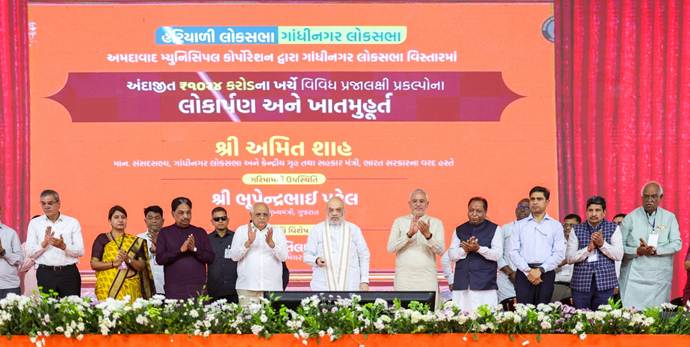
AHMEDABAD — Union Minister of Home Affairs and Cooperation Amit Shah unveiled and initiated infrastructure initiatives valued at nearly ₹1,400 crore in Ahmedabad on Monday. The broad civic rollout—executed jointly by local municipal authorities, the state administration, and central bodies—encompasses major housing redevelopments, smart school upgrades, drainage systems, and transit overbridges across the regional capital. Alongside the capital outlays, Shah outlined an expedited timetable for narcotics eradication, targeting a completely drug-free state by late 2028.
The comprehensive development bundle allocates roughly ₹1,024 crore toward civic infrastructure managed directly by the Ahmedabad Municipal Corporation (AMC), with an additional ₹400 crore sourced through the Road and Building Department of the Gujarat Government alongside central government funding. Chief Minister Bhupendra Patel attended the ceremony, which prioritized urban rejuvenation and public transport infrastructure across the region.
A core focal point of the civic projects centers on urban housing transformation at Ramapir No Tekro. Under the ongoing slum rehabilitation scheme, residents are transitioning into modern apartment units designed to integrate health, educational, and recreational amenities within a single localized ecosystem. Speaking on the historical transformation of the municipality, Shah stated, “The opposition party, which ruled the country and Gujarat from 1947 to 1995, never cared about areas like Ramapir No Tekro. The poor voted for the opposition party for a long time, but their homes were not built.” He noted that the primary schools serving the vicinity have since been transformed into high-tech smart learning institutions.
Transit and utility infrastructure also saw major commitments, including the foundation stone laying for a stormwater pump house in the Bopal-Ghuma zone to eliminate local waterlogging prior to 2029. Works commenced on a four-kilometer signal-free flyover along the ISKCON corridor designed to significantly slash travel times between Sarkhej and Gandhinagar. The administration also inaugurated the Jalaspur Water Treatment Plant. Combined with Monday’s launch, infrastructure spending within the Gandhinagar parliamentary constituency has scaled to ₹25,000 crore over the past seven years under the stated vision of a “Green Gandhinagar Lok Sabha, a Developed Gandhinagar Lok Sabha.”
Shifting focus to public safety, Shah set a statewide narcotics elimination deadline of December 31, 2028—a full year ahead of the national target set for late 2029. Highlighting institutional measures, Shah noted: “Report the sale or consumption of drugs on 1033. Names will remain confidential and strict action will be taken.” He urged families and academic institutions to actively intervene early, clarifying that “de-addiction centers are being established for youth struggling with drug addiction. Do not be shy about treatment; the names of the affected youth will not be made public.”
To bolster enforcement, a dedicated command center will deploy on December 1, mandated to initiate field actions within three hours of receiving actionable intel on illegal drug distribution. Shah closed the address by extending seasonal greetings to the people of Gujarat for Diwali and the upcoming Gujarati New Year (Bestu Varsha).
According to an official press release issued by the Press Information Bureau (PIB), Government of India.
About The Author