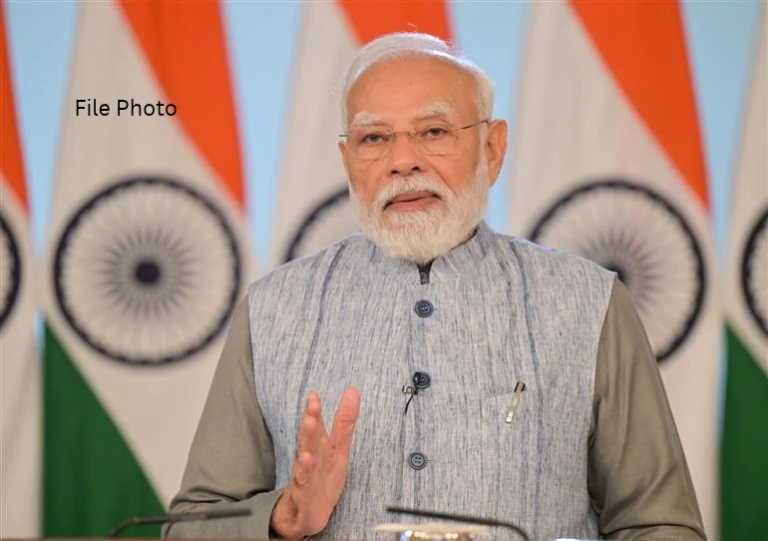
NEW DELHI, November 19, 2026 — Indian Prime Minister Narendra Modi has called upon domestic businesses to look beyond local demand, anchor their long-term capital allocation in national self-reliance, and aggressively compete in international markets. He delivered this message while inaugurating the Annual General Meeting and Annual Convention of the Federation of Indian Chambers of Commerce and Industry (FICCI) at Bharat Mandapam on Thursday, marking the trade body’s 100th anniversary.
Addressing delegates at the centenary event, Modi emphasized that while India’s 140-crore consumer base provides a strong economic foundation, corporations must not treat it as a shield against international competition. “Our domestic market should not be our comfort zone, as it must give us the confidence to compete in global markets,” asserted Shri Modi. He urged enterprises to study international consumer preferences, meet global quality benchmarks, and build overseas distribution networks to capitalize on recently signed trade pacts.
Economic Indicators and Poverty Reduction
Reviewing India’s macroeconomic performance, the Prime Minister cited upward growth revisions from major international financial institutions and record monthly merchandise exports approaching $50 billion in October. “Moody’s Ratings, S&P Global Ratings, Fitch Ratings, the World Bank, and the Asian Development Bank are revising our growth upward,” noted Shri Modi, pointing to projections that place India’s expansion rate near seven percent.
Modi also referenced recent World Bank data indicating that 50 crore citizens exited poverty over a 12-to-13-year span. Attributing this shift to policy execution and public effort, he stated: “Today in India, the pace of progress is also the fastest, and the speed of coming out of poverty is also unprecedented.” Adding his assessment of these findings, he noted, “This report is going to fill all of us with pride,” and maintained, “It shows that the path on which India is walking today is right, accurate, and has the guarantee of the country’s success in it.”
Blueprint for Domestic Manufacturing and Value Addition
Invoking the Sanskrit maxim ‘Uddharet Atmana Atmanam, Na Atmanam Avsadayet’ to underscore the need for continuous self-improvement amid global supply chain disruptions, Modi urged corporate leaders to map out a two-decade roadmap. “In every long-term investment decision of yours for the next 20 years, make India First your foundation,” asserted PM Modi.
To reduce import dependence and move up the global value chain, the Prime Minister identified four priority areas for industrial investment:
- Pharmaceutical Ingredients: While India leads in finished generic drugs, it spends billions importing Active Pharmaceutical Ingredients (APIs) and intermediates. “In finished medicines, we have a strength, and now we will have to build our capability in ingredients as well,” asserted Shri Modi.
- Metals and Minerals: Pointing out that India exports raw iron ore and possesses vast bauxite reserves yet imports specialized steel and aluminum alloys, he stated: “We will have to develop the manufacturing capacity for these products in the country as well,” asserted PM Modi.
- Agri-Food Processing: Noting that India accounts for just 2 to 2.5 percent of global agricultural exports—though processed foods have climbed from 13 percent to over 20 percent of agri-exports in 12 years—he called for dependable procurement chains. “Together we will have to change this situation and view it as a big opportunity for value addition and the food processing industry,” asserted PM Modi.
- Engineering and Machinery: Highlighting low global market share in hand tools, power tools, irrigation systems, and factory machinery for the Global South, he urged large corporations to mentor smaller suppliers. “We can work on this sector to increase our presence in the global market,” remarked Shri Modi.
Fiscal Reforms and Business Environment
Modi also outlined structural tax adjustments designed to stimulate consumption and corporate investment. These measures include reducing the base corporate tax rate from 30 percent in 2014 to 22 percent, exempting personal income up to ₹12 lakh to raise disposable income, streamlining tax refunds, and lowering Goods and Services Tax (GST) slabs across various items. “Its direct benefit is going to our industry and business houses,” observed PM Modi, adding that the government remains receptive to industry policy feedback.
India’s growth story is creating new opportunities. Our industries must be ready to seize them. Speaking at FICCI’s centenary convention. @ficci_india https://t.co/tJCw2NnpjW
— Narendra Modi (@narendramodi) November 19, 2026
FICCI अपनी स्थापना के 100 वर्ष पूरे कर रहा है। एक संस्था का सौ वर्षों तक लगातार सजग और सक्रिय रहना, बदलते समय के साथ खुद को आगे बढ़ाना और देश की आर्थिक यात्रा में अपनी भूमिका निभाते रहना, ये बहुत बड़ी उपलब्धि है: PM @narendramodi
— PMO India (@PMOIndia) November 19, 2026
FICCI ने अपने 100 वर्षों में देश की Industry को बहुत कुछ Achieve करते हुए देखा है। अब समय ये तय करने का है कि Indian Industry अगले 20 वर्षों में क्या Achieve कर सकती है: PM @narendramodi
— PMO India (@PMOIndia) November 19, 2026
अगले 20 वर्षों के अपने हर long-term investment decision में India First को अपना आधार बनाइए। इससे देश आत्मनिर्भर होगा और आपके business की growth के लिए भी नए अवसर खुलेंगे: PM @narendramodi at @ficci_india centenary convention
— PMO India (@PMOIndia) November 19, 2026
हमारा Domestic Market हमारा Comfort Zone नहीं होना चाहिए। हमें इससे वो आत्मविश्वास मिलना चाहिए जिससे हम Global Markets में Compete कर सकें। इसलिए दुनिया के अलग-अलग Regions के Customers की जरूरतों को समझने में Invest करिए: PM @narendramodi at @ficci_india centenary convention
— PMO India (@PMOIndia) November 19, 2026
PIB
About The Author