COLOMBO, Sri Lanka — Member states of the Bay of Bengal Initiative for Multi-Sectoral Technical and Economic Cooperation (BIMSTEC) unanimously adopted a Joint Ministerial Statement in Colombo on Wednesday, launching a coordinated strategy to bolster public health infrastructure, digital medicine, and cross-border emergency response systems.
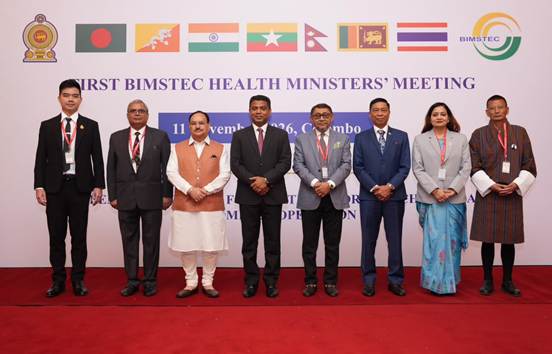
The inaugural BIMSTEC Health Ministers’ Meeting convened representatives from Bangladesh, Bhutan, India, Myanmar, Nepal, Sri Lanka, and Thailand. Chaired by Sri Lankan Minister of Health and Mass Media Dr. Nalinda Jayatissa, the delegates ratified the Revised Action Plan on Public Health (2026–2030), establishing an operational framework for disease surveillance, workforce development, and emergency preparedness through 2030.
Under the agreed terms, member nations will establish specialized centers of excellence across the region. Sri Lanka is designated to host the BIMSTEC Regional Centre of Excellence for Public Health, while Thailand will house the Centre of Excellence on Tropical Medicine. India will establish the BIMSTEC Centre of Excellence in Traditional Medicine at the Institute of Teaching and Research in Ayurveda (ITRA) in Jamnagar, Gujarat, to standardize evidence-based traditional medical practices and research.
Additionally, delegates endorsed a Bangladeshi initiative to create a regional observatory and early-warning framework for zoonotic diseases. The Joint Ministerial Statement also outlines steps toward a shared digital health framework to standardise telemedicine protocols, enable cross-border electronic health records, and deploy artificial intelligence for clinical diagnostics and epidemiological modelling.
India-Sri Lanka Bilateral Accords
The summit coincided with significant bilateral agreements between India and Sri Lanka. Indian Union Minister of Health and Family Welfare J.P. Nadda finalized a Memorandum of Understanding with Dr. Jayatissa to expand Sri Lanka’s emergency transit fleet.
Supported by an Indian grant of 1,725.73 million Sri Lankan Rupees (approximately $5.28 million USD), the deal provides 100 fully equipped vehicles to Sri Lanka’s 1990 Suva Seriya Emergency Ambulance Service. This adds to the 297 units previously funded by Indian grant allocations of $7.5 million in 2016 and $15.02 million in 2018.
India also pledged up to 225 million Sri Lankan Rupees in grant funding to procure 50 diagnostic Medical Kiosks—also known as Health ATMs—for installation across Sri Lanka’s Arogya Primary Health Centres. The deployment forms part of a broader $450 million rehabilitation allocation announced following Cyclone Detwa, which struck the island nation in late 2025. The kiosks will combine point-of-care diagnostics with remote telemedicine capabilities.
Regional Engagements and Governance Framework
On the sidelines of the primary sessions, Indian delegates held talks with Nepal’s Minister of Health and Food Security, Nisha Mehta, focusing on bilateral healthcare access and shared technical expertise. Addressing the conference assembly, Minister Nadda offered to share technical models from India’s public healthcare network, citing operational data from the national e-Sanjeevani telemedicine platform—which has logged over 500 million consultations—and the Ayushman Bharat Digital Mission.
Speaking on global health equity during his address, Shri J.P. Nadda stated, “No country should be left behind in the pursuit of better health outcomes.”
The conference concluded with an agreement to formalize the ministerial gathering as a biennial event. Senior officials and health ministers will convene every two years to monitor implementation targets under the 2026–2030 Action Plan. Thailand is scheduled to host the second BIMSTEC Health Ministers’ Meeting in 2028.
According to an official statement issued by the Press Information Bureau (PIB), Government of India.
About The Author